Anchoring into Concrete: A Contractor’s Guide to Simpson SET-3G Epoxy Requirements
When you are anchoring heavy framing, structural steel columns, or holdowns into existing concrete, mechanical expansion anchors don't always cut it. When the plan calls for maximum holding power—especially in seismic zones or cracked concrete applications—structural engineers almost always specify an adhesive anchoring system.
In California construction, one product rules the job site: Simpson Strong-Tie SET-3G high-strength epoxy.
SET-3G is a structural powerhouse, but it is also highly sensitive to how it is handled in the field. If a framing crew rushes the installation or skips the cleaning steps, the chemical bond fails, and the anchor can pull right out of the concrete under pressure.
Let's break down the exact installation requirements, site conditions, and mandatory special inspections required to use Simpson SET-3G epoxy successfully.
What are the mandatory requirements for installing Simpson SET-3G epoxy?
Simpson SET-3G is an epoxy adhesive system code-approved for cracked and uncracked concrete. To achieve its engineered load capacity, contractors must follow a strict "Hole Cleaning Protocol" (Blow-Brush-Blow), verify that concrete temperatures are between 40°F and 110°F, and secure a Special Inspection sign-off if specified by the structural engineer or local building official.
The Hole-Cleaning Protocol: The "Blow-Brush-Blow" Rule
If you remember nothing else from this guide, remember this: a dusty hole is a failed anchor. When you drill into concrete with a rotary hammer, a thick layer of fine concrete dust lines the walls of the hole. If you inject epoxy directly over that dust, the epoxy bonds to the dust particles rather than the solid concrete.
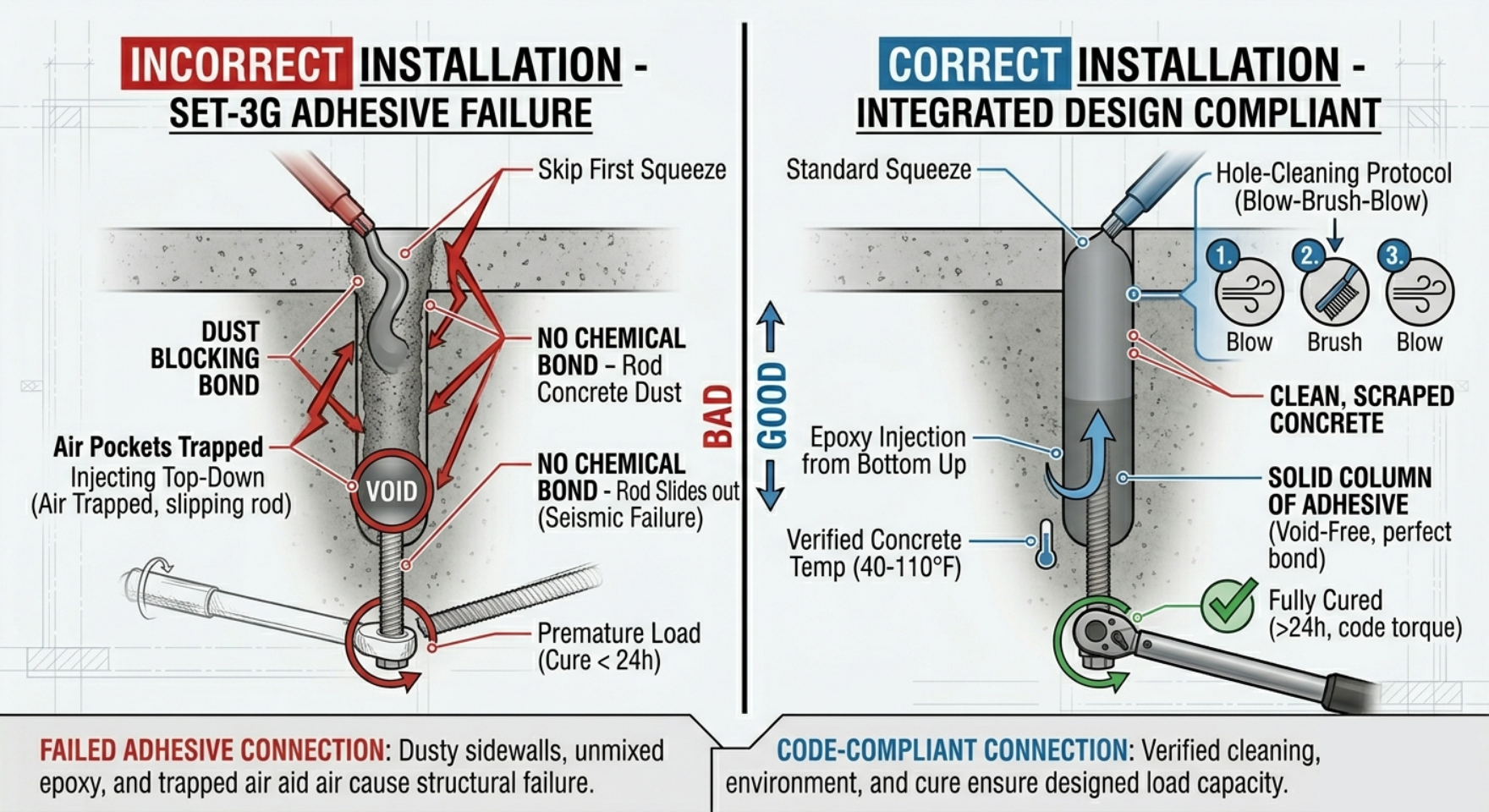
To prevent structural failure, Simpson mandates the "Blow-Brush-Blow" method using their specialized steel wire brushes and a high-pressure air nozzle:
Blow: Use oil-free compressed air (minimum 80 PSI) for at least 4 seconds to blast the loose dust from the bottom of the hole.
Brush: Insert a factory-sized steel wire brush connected to a drill. Run it all the way to the bottom and pull it out at least 4 times to scrape the baked-on dust off the sidewalls.
Blow: Blast the hole with compressed air for another 4 seconds to clear out the remaining debris.
Critical Environmental and Temperature Constraints
Epoxy is a chemical reaction. Like any chemical process, it behaves differently depending on the ambient temperature of the concrete slab.
The Temperature Window: SET-3G is formulated to install in concrete temperatures ranging from 40°F and 110°F. If you attempt to inject it on a freezing winter morning or a scorching summer afternoon outside this window, the chemical composition will alter, ruining its structural integrity.
Cure Time Reality Check: Epoxy does not dry instantly. At a comfortable $70^{\circ}\text{F}$, SET-3G has a working time (gel time) of about 15 minutes and requires 24 hours to fully cure before you can tighten down your nuts or apply any structural load. If the concrete is colder 40°F, the cure time stretches significantly. Do not torque down holdown nuts early.
When Are Special Inspections Required?
Because adhesive anchors rely entirely on human accuracy during installation, building codes do not take chances. Special Inspections are an independent, third-party quality control check mandated by the International Building Code (IBC) and local California jurisdictions.
1. Continuous Inspection vs. Periodic Inspection
Your structural plan set will feature a "Special Inspection Matrix" on sheet S1.0. For epoxy anchoring, it will specify one of two levels:
Periodic Special Inspection: The inspector must arrive on-site to verify the hole depth, the cleaning process (Blow-Brush-Blow), the expiration date on the epoxy cartridges, and the embedment depth of the steel rod. They do not have to watch every single hole get filled, but they must verify the process.
Continuous Special Inspection: The inspector must physically stand next to your crew and watch every single anchor get cleaned, injected, and placed. This is typically required for overhead anchoring installations (like ceiling retrofits) where gravity places the epoxy under sustained tension.
2. The Proof-Load Test
For major commercial retrofits or high-load seismic tie-downs, the structural engineer or local inspector may require a proof-load test. A special inspector will attach a hydraulic ram pull-tester to a designated percentage of your installed anchors, pulling them to a specific structural tonnage to prove they will not budge.
Key Job-Site Traps to Avoid
Skipping the First Squeeze: When you load a fresh dual-cartridge of SET-3G into your caulking gun, the two chemicals mix in the plastic nozzle. The first squeeze or two is usually unmixed and will never harden. Always squeeze the first 2–3 inches of epoxy out onto a piece of scrap cardboard until the color is completely uniform before injecting it into your structural holes.
Injecting from the Top Down: If you stick the nozzle into the top of the hole and pull the trigger, you will trap a large pocket of air at the bottom. When the building experiences a seismic event, that air pocket allows the rod to slip. Always inject from the bottom up, slowly pulling the mixing nozzle out as the hole fills to ensure a solid, continuous column of adhesive.
Fully Integrated Engineering Solutions
At APE Structural Engineering, our team focuses on providing fully integrated designs where every structural component works together seamlessly. We know that structural engineering can be complex ; that's why our primary priority is to balance your project budget and timeline by providing easy-to-follow plans and highly practical building solutions.
Whether you are anchoring a modern single-family residence, an ADU, or a commercial framing layout anywhere in California , we deliver the explicit technical accuracy your team needs to move forward safely.
Are you prepping a structural retrofit or setting up a heavy concrete anchor pour? Let's make sure your details and inspection criteria are perfectly aligned. Contact the APE team today for a reliable, expert design review!