California Retaining Wall Building Codes: When Do You Need an Engineer?
You’re mapping out a beautiful new hardscape for a client. There’s a slight slope in the backyard, so you plan a sleek, modern concrete block retaining wall to level things out. You know the classic California Building Code rule of thumb: Anything under 4 feet doesn't need a permit or structural engineering. You measure the slope, design a wall that sits right at 3 feet high, and figure you’re in the clear. No city hall lines, no engineering fees, just straightforward digging and stacking.
Then, the local code inspector rolls by, spots the work-in-progress, and slaps a big, neon-colored "Stop Work" order on the fence.
What went wrong? You kept it under 4 feet, right?
In California, a 3-foot wall can easily become a 4-foot wall in the eyes of the law—or trigger mandatory engineering for a handful of other technical reasons. Let’s break down exactly why your "short" retaining wall might actually need a structural engineer, so you can avoid costly delays and angry clients.
1. How the California Building Code Measures Retaining Wall Height
The most common misunderstanding in retaining wall design is how we define "height." To a contractor or homeowner, height is what you can see—the distance from the grass to the top cap of the wall.
However, the California Building Code (CBC Section 105.2) defines the height of a retaining wall as being measured from the bottom of the footing to the top of the wall.
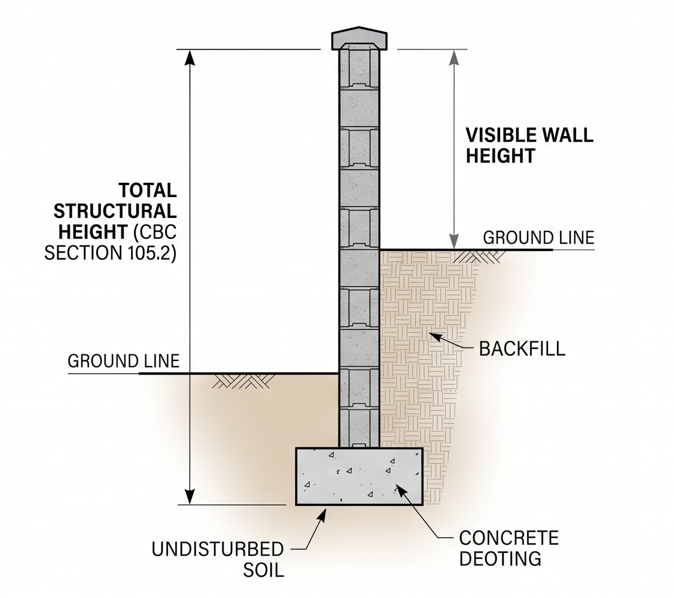
[Image placeholder: Retaining wall cross-section showing footing depth and total height measurement]
Think about how a retaining wall actually works. It doesn’t just sit on top of the dirt like a Lego brick; it requires an underground concrete footing to prevent it from sliding or tipping over. To reach stable, undisturbed soil, that footing usually needs to be dug 12 to 18 inches into the ground.
The Math: If your wall sticks up 3 feet above the ground, but your footing extends 1.5 feet below the ground, your structural wall height is 4.5 feet.
The Verdict: You’ve officially crossed the 4-foot line, meaning a building permit and stamped engineering calculations are legally required.
2. Understanding "Surcharge Loads" (When Soil Gets Heavy)
Let’s say your wall is genuinely tiny—maybe it’s only 2.5 feet tall from the bottom of the footing to the very top. You’re totally safe from the 4-foot rule, right?
Not if there is a surcharge.
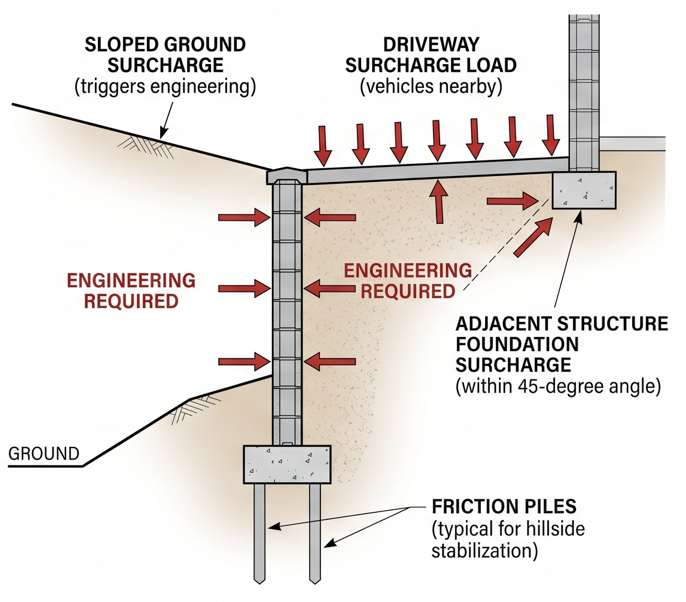
In engineering terms, a surcharge is any extra weight pushing down on the soil behind the wall. The standard code exemption only applies if the earth behind the wall is completely flat and has nothing heavy sitting on it.
The 4-foot exemption completely vanishes, and structural engineering is automatically required, if your wall supports any of the following:
Sloping Earth: If the backyard keeps climbing upward from the top of the wall instead of leveling off, that angled dirt exerts massive extra lateral pressure.
Vehicles & Parking: If there is a driveway, parking pad, or turnaround spot anywhere near the top of the wall.
Structures: If a house foundation, heavy pool deck, or even a heavy privacy fence is built within a 45-degree angle of the wall's base.
3. Local Municipal Amendments Can Be Stricter
While the state-wide California Building Code sets the baseline at 4 feet, local municipalities have the right to enforce stricter rules.
Because we build in highly volatile environments—like the steep hillsides of Los Angeles, the wildfire-prone slopes of Santa Barbara, and the seismically active Bay Area—many local building departments have amended the state rules. It is incredibly common for local jurisdictions to drop the permit exemption threshold down to 3 feet of retained earth, or even require a zoning clearance for anything over 30 inches.
The Retaining Wall Project Checklist
Planning a project? Run through these quick rules of thumb before you dig. If you check any of these boxes, structural engineering is legally required.
Total Height: The distance from the bottom of your underground footing to the top of the wall equals 4 feet or more.
Sloping Earth: The ground slopes upward from the top of the wall rather than laying completely flat.
Surcharge Loads: A driveway, parking area, heavy fence, patio deck, or building foundation will sit on the upper ground near the wall.
Strict Local Zoning: The project is located in a strict local hillside, landslide, or seismic zone with localized city amendments.
How APE Saves You Money on the Ground
Getting a structural engineer involved shouldn't feel like a penalty block. At APE Structural Engineering, we partner with architects, landscape designers, and contractors to make sure walls are optimized, not over-designed.
When a wall gets engineered, we don't just guess; we calculate the exact amount of steel (rebar) and concrete required for your specific soil type. Often, proper engineering allows you to build a cleaner, thinner, and more efficient wall (like choosing between CMU blocks or poured concrete) that actually saves your client money on materials and labor on-site.
Don't let an unpermitted wall stall your next project. If you're planning a hardscape or remodel anywhere in California, reach out to the team at APE. We’ll take a look at your site plan, figure out exactly what the city expects, and keep your project moving forward smoothly!