If you’ve ever peeled back the drywall in a 1920s bungalow or stared up at the massive timber rafters of a mid-century post-and-beam, you’ve seen more than just wood and nails. You’ve seen a "time machine."
In California, structural engineering isn't a static science; it’s an evolution. Every decade of construction was a response to a new discovery, a massive earthquake, or a shift in available materials. Understanding the historical background of structural engineering isn’t just for academics—it’s the key to a successful, cost-effective renovation today.
Here is a look at three distinct "eras" of California engineering and what they mean for your modern project.
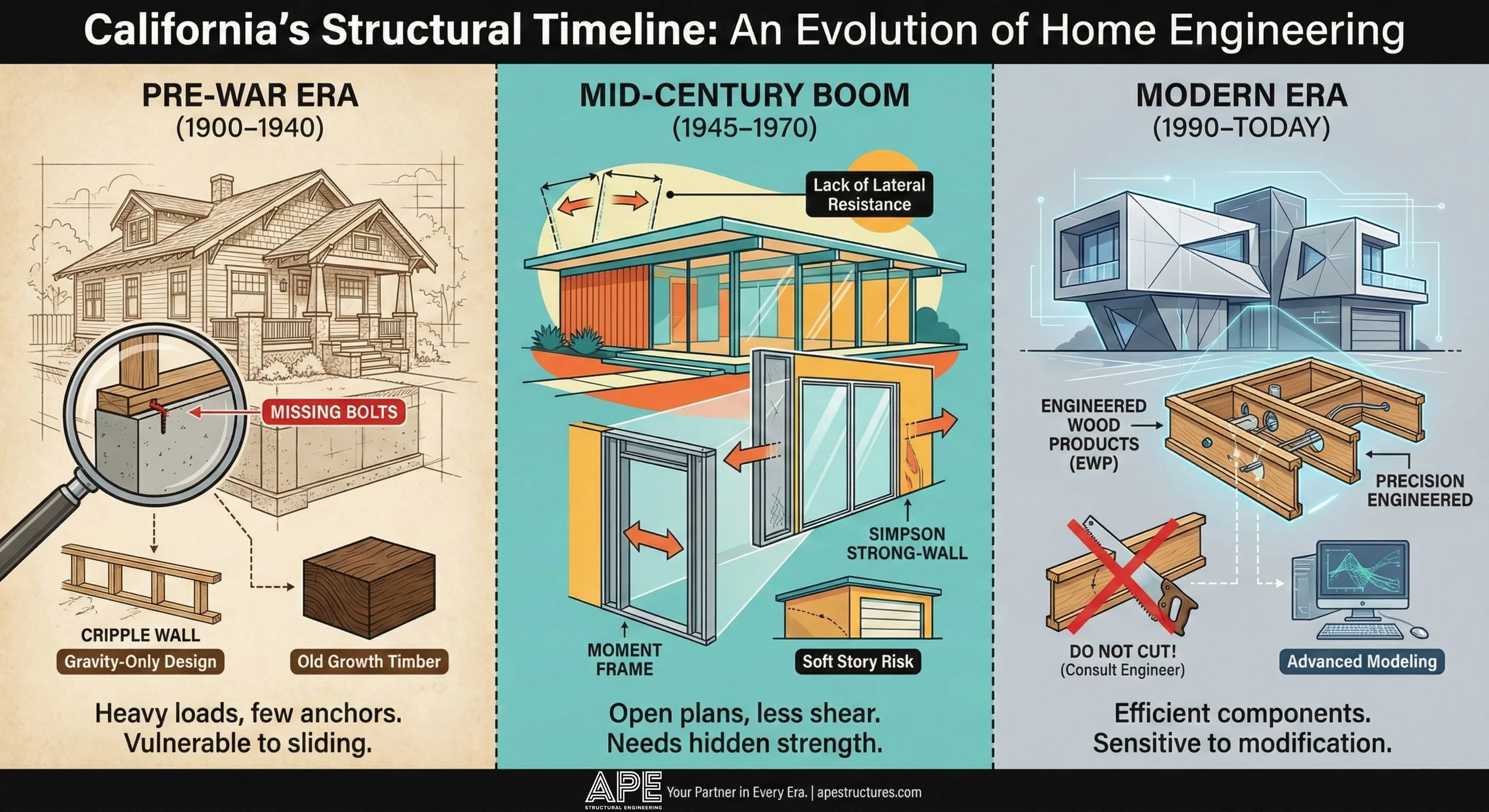
1. The Pre-War Era (1900–1940): The "Gravity-Only" Days
Before the 1933 Long Beach earthquake changed everything, engineers mostly worried about vertical loads (gravity). They built beautiful, heavy homes with "Old Growth" lumber that is incredibly dense and strong—far stronger than what you’ll find at a big-box store today.
The Signature Style: Raised foundations with "Cripple Walls" (those short walls in your crawlspace).
The Structural Quirk: These homes often lack foundation bolts. The house is essentially a heavy hat sitting on a concrete head.
The Modern Fix: Since the wood is so high-quality, these homes are perfect candidates for seismic retrofitting. We don't have to replace the "bones"; we just have to "lock" them to the ground.
2. The Mid-Century Boom (1945–1970): Glass, Steel, and "Thin" Lines
After WWII, California architecture exploded with the "indoor-outdoor" lifestyle. Architects like Eichler and May pushed for massive glass walls and open floor plans. This created a new challenge: without solid walls, how do you stop a house from swaying?
The Signature Style: Post-and-beam construction and "Soft Story" designs (living spaces over garages).
The Structural Quirk: This era relied heavily on the "stiffness" of the roof diaphragm, but often lacked enough lateral resistance (sideways strength).
The Modern Fix: This is where we get creative. To keep those iconic glass walls, we often specify hidden steel moment frames or narrow Simpson Strong-Walls that provide immense strength in a tiny footprint.
3. The Modern Era (1990–Today): The Rise of the Component
Modern engineering is all about efficiency and predictability. We no longer guess how a wall will behave; we use engineered components designed to fail gracefully under extreme stress, protecting the occupants.
The Signature Style: Complex geometries and "zero-energy" requirements.
The Structural Quirk: Use of Engineered Wood Products (EWP) like I-joists and LVLs (Laminated Veneer Lumber). These allow for massive spans but require precise "structural investigation" if you ever want to cut a hole for a new pipe or vent.
The Modern Fix: We use advanced modeling software to ensure every "link in the chain" is exactly as strong as it needs to be—no more, no less.
Why History Matters to Your Budget
When you hire a structural engineer for a renovation, you want someone who speaks the "language" of your home’s era. A "one-size-fits-all" approach leads to over-engineering (which is expensive) or under-engineering (which is dangerous).
By understanding the history of structural engineering, we can identify which parts of your 1920s home are over-performing and where your 1960s home needs a little modern "muscle".
Does your home have a "history" you’re trying to navigate? Reach out to APE Structural Engineering today for a structural investigation that respects your home’s past while securing its future.