Cantilever Backspan Design: The Invisible Rule Every Architect Needs to Know
We all love that architectural "wow" factor. There is nothing quite like a sleek, modern balcony, a dramatic overhanging roofline, or a gravity-defying second story that looks like it’s floating in mid-air. It’s the ultimate design flex.
But behind every stunning cantilevered feature is a structural engineer sweating over a very specific, often invisible detail: the backspan.
If you’re an architect or design-builder dreaming up a bold overhang, understanding cantilever suspension geometry is the secret to keeping your design spectacular without blowing up the construction budget or, worse, causing structural failure.
Let's dive into the physics of the float and look at the golden rule of cantilever backspan design.
What is the Cantilever Backspan Ratio?
What is the 2:1 backspan rule in structural engineering? The standard rule of thumb for cantilever beam support design is a 2:1 ratio. This means that for every 1 foot of cantilevered overhang extending outside the building, there must be at least 2 feet of "backspan" extending inside the building structure to anchor it securely.
Overhang (Exterior): The portion of the beam extending past the support wall (the fulcrum).
Backspan (Interior): The portion of the beam anchored inside the structure.
Total Beam Length: Must equal at least 3x the length of the overhang.
Note: This ratio can change based on heavy snow loads, seismic zones, or concentrated dead loads, requiring custom structural engineering calculations.
The Physics of the Float: How a Cantilever Actually Works
To understand why the backspan ratio is non-negotiable, think of a cantilever as a playground seesaw. The exterior wall or column acts as the fulcrum (the pivot point).
When gravity pulls down on your beautiful floating balcony, it creates a massive amount of downward force on the outside. Because the beam pivots over the exterior wall, that downward force on the outside creates an upward lifting force (uplift) on the inside end of the beam.
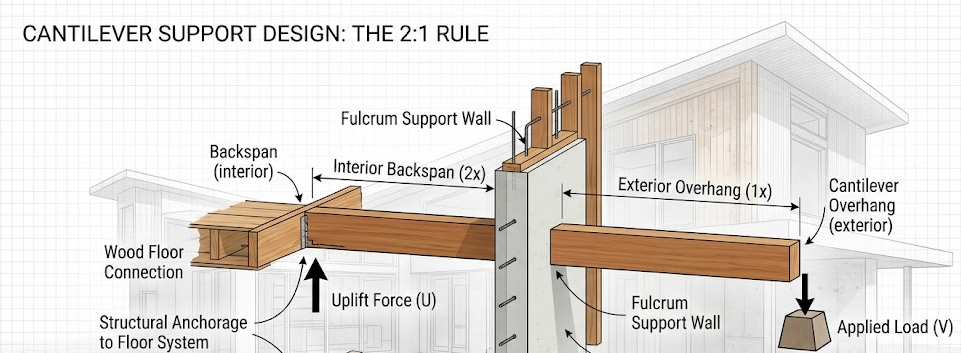
If your interior backspan isn't long enough—or if it isn't anchored down with the right structural hardware—the inside of the beam will literally lift up, tearing through your floor joists and causing the entire cantilever to sag or collapse.
Why a 1:1 Ratio is a Recipe for Structural Drama
It’s tempting to think, "If it’s a 5-foot balcony, can’t I just run 5 feet of beam inside the house?" While a 1:1 ratio sounds perfectly balanced, the physics say otherwise. A short backspan dramatically increases the bending stress on the beam at the pivot point and multiplies the uplift force at the interior connection. To make a 1:1 ratio work safely, you would need massive, incredibly expensive steel elements and heavy-duty tie-downs to fight that leverage.
By utilizing the 2:1 backspan ratio, we let geometry do the heavy lifting. The longer interior tail reduces the internal stresses and leverages the natural weight of the building's interior floors to hold the cantilever down naturally. It’s safer, more efficient, and much friendlier on your client's wallet.
3 Common Cantilever Blunders (And How to Avoid Them)
When designing a modern home or commercial space with cantilevers, keep these structural realities in mind:
1. Forgetting the Floor Joist Direction
A cantilever beam needs to run continuously from the outside in. If your architectural drawings show a balcony extending out from a wall, but the floor joists inside run parallel to that wall, we don't have a direct path for the backspan. Fixing this later usually means dropping massive sister beams or adding heavy steel, which ruins clean ceiling lines.
2. Ignoring the "Bounce" Factor
A cantilever might be perfectly safe on paper, but if someone walks out to the edge of the balcony and feels it vibrate or bounce, it feels unsafe. Deflection and vibration control are massive pieces of cantilever suspension geometry. Engineering for stiffness is just as important as engineering for strength.
3. Overlooking Utility Routing
If you are running thick wood or steel beams deep into the floor system for your backspan, remember that plumbing, HVAC ducts, and electrical lines also need to live in that same floor cavity. Early coordination prevents the classic on-site nightmare of a contractor accidentally cutting a hole through a structural cantilever beam to run a drainpipe.
How APE Structural Engineering Optimizes Your Vision
At APE, we love bold architecture just as much as you do. Our goal isn't to tell you "No, you can't build that cantilever." Our goal is to figure out the most elegant, cost-effective way to make it happen.
By utilizing advanced BIM 3D modeling early in the design phase, we can map out the exact cantilever beam support design alongside the architectural plans. We simulate the loads, calculate the exact backspan requirements, and catch potential framing or utility conflicts in the digital model before a single piece of lumber or steel is ordered.
Whether you’re dealing with tricky seismic zones in Los Angeles, strict coastal requirements in Santa Barbara, or steep slopes in the Bay Area, we optimize the structural efficiency so you keep your clean lines, and your builder keeps their sanity.
Are you working on a design with a complex cantilever, massive glass window walls, or a unique framing layout? Let's collaborate early to keep the structural engineering seamless. Contact the APE team today to talk about your next project!